Showing posts with label cycle. Show all posts

Sunday, 25 September 2016

V-CC Rides 2016


As the summer slips past and cooler shorter days take hold it gives time to reflect on the years rides with the Veteran-Cycle Club. This is not a cycling club, although many members are cyclists. The club is for people interested in old cycles and encourages members to meet and ride these old machines. I was not able to attend all local section rides this year, but I did make the effort to attend as many as I could.  The summer in this part of the world has been wet and often windy.


Events take place across the province of Ulster, the last ride of the summer season was in County Donegal on the Fanad Peninsular. The route afforded some spectacular views of Lough Swilly on reasonably lightly trafficked roads starting and finishing on the quayside at Ramelton. There are buildings on the quayside with a date stone above the door 'L & L S R 1864'. The interesting thing is the Londonderry & Lough Swilly Railway never had a station at Ramelton!


The route went via Rathmullan on the shores of Lough Swilly. A short detour was made to Rathmullan House, now a country hotel. This 18th Century house was bought by Robert Batt who was the youngest son of Narcissus Batt (1760 – 1840) , a founder of the Belfast Bank. The Batt family had property at Ozier Hill, in Co. Wexford and at Purdysburn, Co. Down. Rathmullan House was part of a 4,377 acre estate in 1876. Robert Batt purchased Rathmullan House in 1837 and it remained in family ownership through the generations until 1939. The associated land was bought by the tenant farmers under the various land acts passed by the Liberal Government between 1870 and 1906.


Rathmullan is also notable for seeing the end of the Gaelic Order with the 'flight of the Earls' to the continent of Europe. There is a statue on the foreshore below the Victorian Coastguard cottages at Rathmullan, to commemorate the event.


One of joys of taking part in the V-CC rides is to see a newly restored machine make it's debut back on the road.  Cycles which made an appearance this year are a Sunbeam roadster, Claud Butler Lady's bike and an early Leader of Croydon.


The weather was kind for the last summer run and the food bought in Rathmullan was excellent.  A pleasant ride back to the start followed as the clouds cleared. The tide had come in at Ramelton by the time of our return.  The run ended with a lovely sunset to round off a great day.

Saturday, 10 September 2016

Winter Bike


As the evenings draw down and the days shorten, thoughts turn to unearthing the winter bike. We have not had much of a summer here, generally very wet. The trees started losing their leaves at the end of July, to the point, a maple in the garden is nearly in winter mode apart from the seeds still on the tree.

I suppose it is a left over of my cycling apprenticeship of decades ago, where you had a heavier winter, or hack bike, equipped with mudguards, on which to maintain fitness, keeping your prize machine in good trim for the following racing season. The other reason was using your heavier hack bike would give you an advantage when you changed to your lighter race bike at the start of the new race season.

I started off my cycling career a Hi-Ten Raleigh sports bike and covered thousands of miles on this humble machine. My winter bike was purchased secondhand in the 1980s as a complete bike. Bike was stripped and frame painted by hand. It was a cheap sports bike, confirmed when I stripped the frame to reveal seamed frame tubes. It has had a number of repaints since and still going strong. The bike originally was fitted with a double chainset and Suntour derailleur gears. I had the frame professionally re-enamelled by Bob Jackson years ago, taking advantage of their £50 re-enamelling offer. I chose to have the frame painted black with a maroon headtube, reminiscent of the 1930s BSA Sports.


Around 2009 I rebuilt the bike as a fixed gear machine. It rode well enough in this trim except for the fact my arthritic knees protested at the fixed gear. I liked the fact there was no derailleur gears and freewheel block to attract road dirt and the workings affected by winter road salt. I needed a freewheel to ease the workload on my knees and would like a few gears, but keeping the simple drive train. The solution suggested itself when I rescued a 1960s Sturmey-Archer AW3 wheel dumped in a local bog. The challenge was, could I strip it down and get it going again? I managed to achieve the first and following a thorough clean achieved the second, however the left hand ball cup was badly worn. The hub was the Mk3 with the pressed in ball cup and the bottom gear would never work. I aimed to have a middle gear of around 60 inches, with a top gear under 80 inches. Sturmey-Archer 3 speed hubs tended to be fitted to bikes with too high a gear in my opinion. I ended up fitting a 22T sprocket to my hub gear.


I also took the opportunity when converting the bike to hub gear operation, to build a new front wheel too, incorporating a Novatec hub dynamo. These were getting long in the tooth when I bought mine and could be bought cheaply on ebay. The downside of the hub was the resistance in the dynamo when riding with lights off. It is not actually such a drawback riding with the lights permanently on as the short days and overcast weather mean you are more easily noticed by motor vehicles. Whether they actually make room for you on the road is another matter…..


I used Busch and Muller LED lights on the bike and routed the twin wire cables on the outside of the plastic mudguards. I used pieces of plastic tube glued to the mudguard with epoxy to retain the wires. The tubing came from used liquid soap bottles, being the bottom part of the soap dispenser assembly. Not very elegant, but it works and is in keeping with my bargain basement ethos for my winter bike. I still have the adapted Ever Ready plastic rear light fitted to my old 1970s Carradice Nelson longflap saddlebag. The light was fitted to a custom made aluminium bracket which fits into the offside side pocket of the saddlebag. I always found it useful to have a rear light on the offside of the bike as well as the central rear light. No excuse for a motor vehicle not to give you enough room when passing.


The parts fitted to my bike have all been cascaded down from other bikes over the years, except the wheels and mudguards. The seatpost is an old alloy SR Laprade fluted model. The headset is an old 'Red S' sold by Freewheel in their mail order catalogue. It was actually a Stronglight A9 needle bearing alloy and plastic copy. The cranks are odd cranks, the right being an SR Custom fitted with a single chain ring and the left a Stronglight. They are the same length though! Bars were a modern replacement 44cm for the old narrow SR bars. The stem is 3T. The saddle is an old Cinelli off my MKM racing bike and is now worth too much to leave it on my bike. I have an old Brooks B17 to replace it with. The Cinelli will be re-used in a restoration.


I always like the idea of the old Sturmey-Archer 3 speed quadrant lever mounted on the top tube of bikes in the 1930s. I couldn't get any modern lever to fit onto the top tube of my bike. Instead I used a lever designed for use on 22mm handlebars on the handlebar stem of my bike, with a cable stop on the top tube and the cable routed via a pulley wheel down the seat stay to the dropout. An old fashioned idea, which works well and looks neat on the bike. I will rebuild the back wheel with a new Sturmey-Archer 3 speed hub gear in the next few weeks, so the bike will be ready for when BST ends.

Monday, 23 May 2016

1986 Ammaco 'Monte Carlo' Restoration - stripping the frame


The Springhill Cycle Collection recently acquired a 1986 Ammaco 'Monte Carlo' road bike. The seller has asked for photographs of the restored machine and it is intended to move this restoration up the works list.

Ammaco came to notice in 1985 when they jointly sponsored the 1980 and 1985 British UCI Professional Pursuit Champion, Tony Doyle with RMC-Security Grille Protections. Tony's professional Ammaco branded frames were built by Charles Roberts in London. The Ammaco professional team consisted initially of Tony Doyle but for 1986 became Ever Ready-Ammaco and also had Australian Danny Clark and Nigel Dean on their strength. The team increased in size to 7 riders for the 1988 season which marked the end of Ammaco's involvement as a major sponsor of professional cycling in Britain. The Ammaco brand is sold by the family owned chain of Cycle King cycle shops based in the English Midlands and southern England.  A major selling point appears to be price. 


The 1986 Ammaco bike frame has 3 x 4130 Cro-mo main tubes, but the forks are Hi-Ten.  The handlebar stem is a heavy 80mm alloy of Taiwanese manufacture and would indicate this is probably the source of the lugged steel frame. What is obvious is that price point was a major selling point, along with the similar colour scheme and branding to the professional team bikes. Having bikes and frames produced in the far east was nothing new as the now defunct Evian (G.B.) Limited had marketed a range of 'Hirame' branded bikes and frames in the late 1970s/early 1980s produced by Kuwahara in Japan. Their range started with Hi-Ten tubed road frames up to full Ishiwata tubed road frames. The Hirame frame in the Springhill Collection is nicely made with Kuwahara's own forged drop-outs.

The Ammaco machine came with some original parts, but the original paintwork is now very tired and in need of renewal. The frame has 'Ammaco' branded seat stay caps and fork crown. The first problem to be addressed for any potential restoration will be that of the availability of original pattern transfers/decals. The second problem is the actual stripping down of the bike, specifically, whether the seat post and handlebar stem are seized in the frame and the alloy cranks seized onto the steel crank axle. I intend to deal with the stripping down of the bike here. 


The threads for the screw in crank extractor were very, very dirty and required cleaning with Brunox and Scotchbrite before wiping clean with kitchen roll. The crank extractor then had to be carefully screwed into the righthand crank, checking that it was square to the crank as the initial first threads were damaged.  I wanted to make sure the remover was not cross threaded before fully screwing the remover home using a spanner/wrench.  Thankfully the crank did move relatively easily and the left crank was also successfully removed without any damage.  The chainset is a Japanese made Sugino 42/52T.  The chainrings are steel which are swaged onto the alloy crank.  It was typical fare on lower end sports road bikes in the 1970s/1980s with Peugeot using swaged Stronglight or Nervar and British manufacturers such as Dawes, Falcon or Raleigh using SR Silstar. The seat post was chromed steel and although rusty came out with the use of Brunox. The handlebar stem being alloy was more of a problem.  It was seized into the fork steerer tube.


I have written an earlier post about dealing with a seized handlebar stem.  The one thing to recognise is that it takes time to corrode in, so it logically follows, that it will take a bit of time to unseize it!  The first job was to put some PlusGas around the top of the headset locknut/handlebar stem interface and leave it for several hours.  I removed all the other components from the frame, chain, brake callipers, gear levers, front and rear derailleurs. The wheels were removed last and then the frame up ended so I could pour some more PlusGas down into the fork steerer tube and then leave it to soak for 3 days.  The wheels were then refitted to the frame, the allen key expander bolt loosened which showed the retaining bolt was still stuck in the fork head tube.  A sharp tap with a soft faced hammer released it, so the next thing was to try moving the handlebars and stem. I chose to use the original handlebars rather than substitute them for an MTB handlebar which would offer better leverage.   I wanted to initially try to see if I could move the stem with the steps I had already taken.  Obviously if I had failed, then it would have been back to a soak of PlusGas for a longer period and use of the longer MTB handlebar lever to break the bond. 

After gripping firmly and applying leverage, the stem moved. Brunox was then applied and the steerer moved again.  More Brunox was applied and the steerer moved more easily.  The same process was repeated until the stem was moving relatively easily and pulled upwards and out of the fork steerer tube.  There was plenty of evidence of galvanic corrosion on the shaft of the alloy stem as no grease appears to have been used to prevent it.  The photo shows the alloy stem after a quick clean with a brass brush. One alarming thing that did happen was one of the fork drop-outs cracked.  The fork drop-outs have the slot in the drop-out for the tang of a washer for what is euphemistically referred to as 'lawyers lips'. The drop-out cracked at this slot.   The frame will now have to go to a framebuilder for repair before it can be re-enamelled.


The frame once stripped is actually reasonably light.  The frame number is stamped into the bottom of the seat tube at the righthand (crank) side just above the bottom bracket shell.  The gear tunnels are plastic, afixed to the underside of the bottom bracket shell with a 5mm Phillips screw.  The frame has a chain stop brazed onto the righthand seat stay, double gear lever bosses brazed onto the down tube and three cable guides on the top of the top tube.  I will deal with components and transfers/decals in future posts.


Saturday, 30 April 2016

Cleaning alloy cycle components


I was doing some internet searching in relation to a bike I had to work on for the Springhill Cycle Collection. The bike, an early 1970s model, had been stored in less than ideal conditions and the alloy components were showing signs of surface corrosion - not been cleaned before it was stored. The components were a Spanish copy of Campagnolo and in parody of the great Roman cycling god, the copies were named after the ruler of the Greek Olympian gods, Zeus. Frank Berto in his tome 'The Dancing Chain' doesn't rate Zeus components. Zeus components were never very common in this part of 'the oul sod', so to get a bike equipped with Zeus is unusual. The bike is local, has been ridden and used judging by the layers of dirt and wear to the parts. Anyway to return to the point, the large flange hubs are not Zeus and turned out to be of Japanese origin. I haven't seen photos of this particular model of hub on the web.


However, here at Methuselah Towers I have a confession to make. I haven't bought a news stand cycle magazine in 10 years and don't frequent internet forums, so therefore cannot claim any kind of expertise other than experience. So I have to defer to the 'experts' on the web, who advocate using various grades of abrasive papers and buffing wheels to polish alloy components. Personally I would have grave reservations about such an aggressive approach, as I have experience of alloy components such as Campagnolo and Stronglight cracking and failing. I also don't agree with re-polishing old alloy to a very high surface shine, far removed from the original finish. To me it detracts from the originality of the parts/machine and can, in my humble opinion, be a case of 'over egging the pudding'.


I prefer a more subtle approach, one advocated by a long forgotten source. I was told to use a brass brush to clean alloy and then wipe the surface with oil. I now prefer to use WD40 or an equivalent solvent, on a soft cloth or a bit of kitchen roll, to wipe the burnished alloy. The brush will get rid of the surface bloom and expose the nature and extent of any surface pitting and corrosion. A decision can then be made about re-polishing if deemed necessary. It is surprising how much the brass brush will clean up the alloy, whilst still leaving a sympathetic finish to the metal. Where the corrosion is not too deep it can be polished out after cleaning, using Autosol and a soft cloth. A final clean with a silicone based car polish will give it the final seal as you have in all likelihood removed the original anodised finish. I have tried to show a few before and after photos to illustrate the point. The Maillard small flange hubs are ones I rescued from the scrap bin of a cycle business. 


Remember that you will need to keep an eye on your repolished alloy as it will now be more susceptible to corrosion as the anodised coating has been removed!


Thursday, 24 December 2015

Merry Christmas - Joyeaux Noël - Weihnachtsgrüße

I would like to take the opportunity to wish all my readers 'seasons greetings' from this corner of Ireland.  The weather has not been that kind of late with one storm system after another depositing lots of liquid sunshine outside. With the strong winds, the only variation appears to be the 'angle of attack' of the liquid stuff. 2015 has been very wet and I would expect the yearly average to be at least 130% above the statistical mean.


Despite the gloomy weather, things move on apace and 2015 did see one or two highlights for me.  I did manage to get my Goeland Randonneuse out a few times for a run.  I really like the way the bike rides. Frame is 531 tubing and bike came equipped with 650B Michelin 'World Tour' tyres.  They are amber wall tyres and it is over 30 years since my bike was equipped with Michelin 'World Tour' tyres, so the clock has been well and truly wound back.  The Goeland dates from 1960 but the rear derailleur was updated in the 1970s to a Huret 'Duopar' long cage mech.  The only thing I have added to the bike was a Lion Bellworks engraved brass bell.  I really like these and unlike the alloy 'ping' bell that equipped my racing bike in the 1970s, this one has a loud, lingering melodious ring.  Despite it's efficacy for those of normal, unobstructed hearing, the bell's performance is limited, especially where joggers and walkers are concerned, those who are plugged into their personal music player but 'tuned out' of the real world.


A friend completed two restorations over the winter of 2014/15.  The first was a 1938 Saxon Twin Tube.  His reason for wanting another Saxon was the fact his father ran a cycle shop before and after WW2 and was an agent for Saxon.


His second bike was even more personal.  It was a Hill Special from Padiham, Lancashire and was one of four frames his father had bought to sell through the shop in the early 1950s.  The bike was one of these four and had one owner from new.  He was able to buy it back from the owner as he had got too old to ride it. The bike was actually built up by his sister and given the 'once over' quality control check by his father to make sure the bike was up to spec before it left the shop.  Components are original to the bike and have been re-chromed and polished where required.


The staff at the Springhill Cycle Collection have received a new recruit in keeping with the ethos of the collection.  Meg, a rescue dog, has joined the staff in a supervisory role. Apart from watching, to make sure the restorations are up to standard, she has undertaken the onerous task of dealing with the dodgy catering. She has to be let into this role slowly.....


Friday, 24 July 2015

Cycles George Martin, Lyon


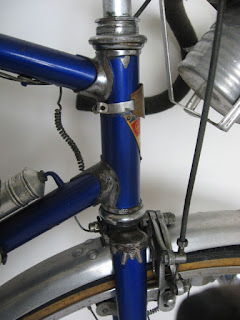
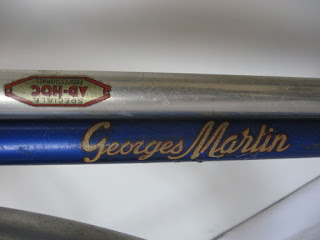
The bicycle is a rare 1952 Georges Martin randonneuse and was made in Lyon, France.  The bicycle has 700C wheels, and is similar to machines raced in events such as the Poly de Chanteloup. The bicycle does not have a decaleur, nor a sacoche. The bicycle is completely original, down to the tax plate on the head tube with the original owner's details. The machine has some rare, high end and unusual parts.

Georges Martin was born in Chamelet, Rhone Department, France in 1915 and died in Poule-les-Écharmeaux in 2010 aged 94 years. Georges rode professionally for J FOLLIS, Lyon. He is credited with one hundred victories according to the excellent Anciens Velos Lyonnaise website. Georges rode and won the Circuit de Six Provinces in 1946:- 
 
                                            1. Georges Martin,
                                            2. Pierre Baratin,
                                            3. Raphaël Géminiani.

Both Martin and Baratin were team mates for FOLLIS. Georges rode in the first post war Tour de France in 1947. The teams were national teams, but teams from both Germany and Italy were missing, an Italian team being composed of Italian-French. Georges Martin rode for a regional French Team – Equipe du Nord-Est.


The 1947 Tour started in Paris on 25th June 1947 and comprised of 21 stages, there were 99 starters, but only 53 riders completed the race, which was won with an average speed of 31.412km/hr. The top three podium places were all filled by French riders:-
                                            1. Jean Robic,
                                            2. Édouard Fachleitner,
                                            3. Pierre Brambilla.
Georges Martin rode in the 1948 edition of the Tour de France achieving 39thin the General Classification (G.C.) at the end of the race. The 1948 Tour was won by Gino Bartali in an average speed of 33.442km/hr. 


Georges rode the 1949 Tour improving his overall position to 35th overall by the end of the race. The 1949 Tour was won by Fausto Coppi in an average speed of 32.121 km/hr. The speeds seem slow by modern standards, but stages could be longer and the mountain stages were run on un-metalled roads. Georges Martin also rode the 1949 Classic Paris - Roubaix achieving a position of joint third with Frans Leenan and Jésus-Jacques Moujica
 

I have no information on the colour of the 1940s FOLLIS team frames and trade jerseys. There is some evidence that the 1950's FOLLIS team jersey was green with a wide grey centre band on which the lettering was red. The colour of the team bikes was a metallic grey, with contrasting head and seat panels in pale metallic blue. Forks were chrome plated along with the head lugs. Earlier frames had the 'J FOLLIS' metal head badge. It is known that FOLLIS supplied frames to the cycle trade. FOLLIS had been granted a patent for the manufacture of lugless frames in Janury 1949. A WOLHAUSER (Lyon) tandem lugless frame is known, which shows all the features of being made by FOLLIS but has a WOLHAUSER metal head badge and transfers. 
 

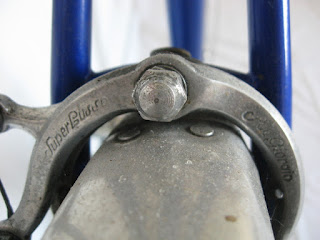
I now know that Georges Martin finished riding professionally in 1950, but he began selling bicycles under his own name firstly at 78 Rue de la Part-Dieu, Lyon, then at 101 Rue Moncey, Lyon and finally at Rue du Noir, Lyon. The Georges Martin bicycle in the Springhill Cycle Collection dates from 1952 and shows a lot of features of an early edition FOLLIS frame. The frame fittings and wrap over seat stays are typical FOLLIS, but the fork crown is unique to Georges Martin. Given his connection to FOLLIS and the fact they were known to supply frames to the cycle trade, the evidence points to Georges Martin's frames having been built by FOLLIS and appear to have been built from Vitus tubing. However, Georges Martin was interviewed by a French researcher before his death. The truth of some of his testimony is in doubt, as known facts are different to Georges' version. What is known is that Georges Martin bicycles are rare in France. The bicycle in the Springhill Collection is in original condition complete with period components, Simplex derailleur, Pellisier hubs and Ava rims, Beborex brake levers with 'San Giorgio' brake callipers, 'Radios' dynamo and lights, Mavic 'Inal' mudguards/fenders, Selle Anglais leather saddle. The machine has the original French tax plate with original owner's name and address still attached to the frame. The only replacement parts appear to be the Christophe leather toe straps. 
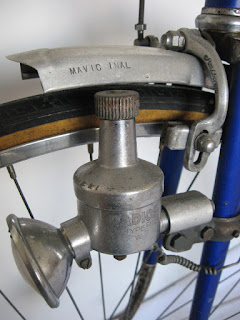

The machine has 700C wheels and appears to be set up for cyclotourist competitive events. The December 1950 issue of the CTC Gazette contains a report on the Paris Bike Show of that year. Their correspondent reports on the number of constructeur Demi-Course and Randonneur bicycles at the show.  A Demi-Course bicycle has mudguards/fenders and lights but no decaleur for a sacoche/handlebar bag. Recourse to photographs from the 1950s of the Poly de

Chanteloup randonneurs event, show machines being ridden with mudguards and lights but no racks or bags. Some of these machines have the alloy drinks bottles in a cage attached to the handlebar as per the Georges Martin in the Springhill collection. The 1950 Poly de Chanteloup was won by FOLLIS, Pierre Baratin winning the professional hillclimb and Roger Billet winning

the randonneur event for FOLLIS. Since the end of competative cycletourist hillclimbs, time trials and endurance events in France from 1977, the term Demi-Course now seems to refer more to cheaper mass produced machines made from Hi-Ten tubing, rather than a bespoke hand built bicycle around an artisan constructeur built frame for cyclotourist competition. The Georges Martin in the Springhill Cycle Collection is a lightweight steel frame built up with high quality, for the time period, components.

Joseph (Giuseppe) Follis was born in Alpignano, near Turin on 16th October 1911 and after living and working in Lyons became a naturalised French citizen on 11th March 1940, before Italy declared war on France on 10th June 1940. 
According to eye witnesses Joseph Follis had worked for Morel & Vana, Lyon in the 1930s and was responsible for the production of their FORTIS brand of bicycles. Following closure of the company, Joseph moved to the Rue du Dauphiné where he brazed frames in a wooden hut at the bottom of the garden. The Follis family were innovators who were granted patents for derailleur gears, manufacture of frames and bicycle brakes. The patent granted to the Follis family for a bicycle brake in November 1951 corresponds in principle to the locally (Lyon) manufactured BEBOREX brakes and levers. FOLLIS is perhaps not a French marque that is as well known as say LeJeune, Helyett, Peugeot, Mercier and Motobecane. The two known professional riders in the 1940s were Georges Martin, Pierre Baratin and André Mossière who rode cyclocross events. 
The FOLLIS professional team in 1954 ~ 1956 period included René Remangeon, Normand Christian Fanuel, Roger Chaussabel and Jean Forestiere. There were photographs of Roger Rivière with his bike published in 'Sport et Vie' in his last year as an amateur which identify it as a FOLLIS by the head badge. There is still more to be learned about both Georges Martin and the FOLLIS marque. 

George's daughter held a retrospective two day exhibition in Poule-les-Écharmeaux entitled in english – 'Georges Martin, the heroic years of the Tour de France' on 9 – 10th July 2011, the year after Georges had passed. I wish I could have been there.