Showing posts with label Randonneuse. Show all posts

Monday, 21 October 2019

' Cycles de France ' Book review

I saw a post earlier this year on social media about a new book published called
' Cycles de France '. The book is obviously written in French and only available from the co-author Patrick Munoz. The front cover image whetted my appetite as the quality of the images were comparable to the book ' The Golden Age of Handbuilt Bicycles ' by Jan Heine.

Firstly, the book and dust jacket are beautifully printed. My copy came wrapped in clear plastic inside the cardboard packaging. The book is hardback with an attractive dust wrapper. The end papers in the book are of heavier paper and the book itself has 194 pages. Philippe Montagne is responsible for the text and Patrick Munoz for the superb photographs.


The book is an illustration of high quality hand made French bicycles. The book starts with bicycles from the early 20th century and then progresses to the work of the artisan builders. The book is roughly divided equally between the Paris constructeurs and those from the regions. Of those, the constructeurs from the Lyon region form the largest group outside Paris. The book is interesting because of the number of aluminium frame bikes which are illustrated. However, probably the best known early brand of aluminium bike to the english speaking world - Caminargent, doesn't feature. Instead the authors chose to have an earlier steel frame Caminade illustrated (pages 20-21). I found that very interesting and shows the author's approach to avoid cliche.


So, the authors illustrate the aluminium frames of Nicola Barra, Paris and the work of regional constructeurs Andre Sabliere, Andre Marcadier, and Raymond Clerc. The book features three lady's bikes. Two 'mixte' frames, a Hugonnier-Routens in steel (pages 58 - 59) and a Velo Barra in aluminum (pages 82-83). The third bicycle is a 'Dame Anglais' by the Paris constructeur Cycles Innovation (pages 56-57). I know this style of frame is unusual, as the Springhill Cycle Collection holds a very rare Andre Bertin 'Dame Anglais'.


By far the biggest number of bikes illustrated are those of Rene Herse, followed by those of Nicola Barra and Alex Singer in third place. What did surprise me was, only one example of the work of Louis Moire - Goeland and nothing of Oscar Egg's work. Surprising given his cycling history that the work of this Parisien constructeur is absent. Perhaps the authors have been constrained by space?


The racing scene has not been ignored. Two track bikes and three road bikes used by professionals feature. The bike used by an amateur J Anquetil built around a Barra frame is also featured. Of the professional bikes, the one I remember the best is the Gitane Profil. I recollect Bernard Hinault riding it in the Tour de France. The frame was made from specially drawn Reynolds 531 tubing which was not available to the great unwashed. Given the involvement of Peugeot, Helyett, LeJeune and Liberia in the professional peloton, no examples feature. The Mercier ridden by Joop Zoetemelk was actually built by Bernard Carre, confirming many of the stories from my youth.


The book cost 60 euros plus postage. I was given the option of regular postal delivery or having my parcel tracked at extra cost. I chose to have the parcel tracked to ensure delivery.

Do I think the book is worth the purchase price? A resounding YES. I have highlighted a few omissions I was surprised at, but, in fairness the authors have a very rich vein to tap and that wealth of material out of necessity has be constrained by the limitations of size and cost of their book. A further question would be, are there any bikes featured, which do not deserve to be in the book? The answer would have to be, NO. So the authors have done a good job. I would love to see a second volume, by these same authors, featuring more constructeurs not covered in this beautiful book. The French have an amazing cycling history and their passion for both the bicycle and the sport covers many disciplines. That variety is accurately reflected in this volume. It is a tribute to both authors that this book is a jewel for anyone interested in French bicycles. I can heartily recommend this book.

If you wish to order a copy of this book, email Patrick Munoz at:- cyclesdefrance@outlook.fr

Friday, 24 July 2015

Cycles George Martin, Lyon


The bicycle is a rare 1952 Georges Martin randonneuse and was made in Lyon, France.  The bicycle has 700C wheels, and is similar to machines raced in events such as the Poly de Chanteloup. The bicycle does not have a decaleur, nor a sacoche. The bicycle is completely original, down to the tax plate on the head tube with the original owner's details. The machine has some rare, high end and unusual parts.

Georges Martin was born in Chamelet, Rhone Department, France in 1915 and died in Poule-les-Écharmeaux in 2010 aged 94 years. Georges rode professionally for J FOLLIS, Lyon. He is credited with one hundred victories according to the excellent Anciens Velos Lyonnaise website. Georges rode and won the Circuit de Six Provinces in 1946:- 
 
                                            1. Georges Martin,
                                            2. Pierre Baratin,
                                            3. Raphaël Géminiani.

Both Martin and Baratin were team mates for FOLLIS. Georges rode in the first post war Tour de France in 1947. The teams were national teams, but teams from both Germany and Italy were missing, an Italian team being composed of Italian-French. Georges Martin rode for a regional French Team – Equipe du Nord-Est.


The 1947 Tour started in Paris on 25th June 1947 and comprised of 21 stages, there were 99 starters, but only 53 riders completed the race, which was won with an average speed of 31.412km/hr. The top three podium places were all filled by French riders:-
                                            1. Jean Robic,
                                            2. Édouard Fachleitner,
                                            3. Pierre Brambilla.
Georges Martin rode in the 1948 edition of the Tour de France achieving 39thin the General Classification (G.C.) at the end of the race. The 1948 Tour was won by Gino Bartali in an average speed of 33.442km/hr. 


Georges rode the 1949 Tour improving his overall position to 35th overall by the end of the race. The 1949 Tour was won by Fausto Coppi in an average speed of 32.121 km/hr. The speeds seem slow by modern standards, but stages could be longer and the mountain stages were run on un-metalled roads. Georges Martin also rode the 1949 Classic Paris - Roubaix achieving a position of joint third with Frans Leenan and Jésus-Jacques Moujica. 
 

I have no information on the colour of the 1940s FOLLIS team frames and trade jerseys. There is some evidence that the 1950's FOLLIS team jersey was green with a wide grey centre band on which the lettering was red. The colour of the team bikes was a metallic grey, with contrasting head and seat panels in pale metallic blue. Forks were chrome plated along with the head lugs. Earlier frames had the 'J FOLLIS' metal head badge. It is known that FOLLIS supplied frames to the cycle trade. FOLLIS had been granted a patent for the manufacture of lugless frames in Janury 1949. A WOLHAUSER (Lyon) tandem lugless frame is known, which shows all the features of being made by FOLLIS but has a WOLHAUSER metal head badge and transfers. 
 

I now know that Georges Martin finished riding professionally in 1950, but he began selling bicycles under his own name firstly at 78 Rue de la Part-Dieu, Lyon, then at 101 Rue Moncey, Lyon and finally at Rue du Noir, Lyon. The Georges Martin bicycle in the Springhill Cycle Collection dates from 1952 and shows a lot of features of an early edition FOLLIS frame. The frame fittings and wrap over seat stays are typical FOLLIS, but the fork crown is unique to Georges Martin. Given his connection to FOLLIS and the fact they were known to supply frames to the cycle trade, the evidence points to Georges Martin's frames having been built by FOLLIS and appear to have been built from Vitus tubing. However, Georges Martin was interviewed by a French researcher before his death. The truth of some of his testimony is in doubt, as known facts are different to Georges' version. What is known is that Georges Martin bicycles are rare in France. The bicycle in the Springhill Collection is in original condition complete with period components, Simplex derailleur, Pellisier hubs and Ava rims, Beborex brake levers with 'San Giorgio' brake callipers, 'Radios' dynamo and lights, Mavic 'Inal' mudguards/fenders, Selle Anglais leather saddle. The machine has the original French tax plate with original owner's name and address still attached to the frame. The only replacement parts appear to be the Christophe leather toe straps. 


The machine has 700C wheels and appears to be set up for cyclotourist competitive events. The December 1950 issue of the CTC Gazette contains a report on the Paris Bike Show of that year. Their correspondent reports on the number of constructeur Demi-Course and Randonneur bicycles at the show.  A Demi-Course bicycle has mudguards/fenders and lights but no decaleur for a sacoche/handlebar bag. Recourse to photographs from the 1950s of the Poly de

Chanteloup randonneurs event, show machines being ridden with mudguards and lights but no racks or bags. Some of these machines have the alloy drinks bottles in a cage attached to the handlebar as per the Georges Martin in the Springhill collection. The 1950 Poly de Chanteloup was won by FOLLIS, Pierre Baratin winning the professional hillclimb and Roger Billet winning

the randonneur event for FOLLIS. Since the end of competative cycletourist hillclimbs, time trials and endurance events in France from 1977, the term Demi-Course now seems to refer more to cheaper mass produced machines made from Hi-Ten tubing, rather than a bespoke hand built bicycle around an artisan constructeur built frame for cyclotourist competition. The Georges Martin in the Springhill Cycle Collection is a lightweight steel frame built up with high quality, for the time period, components.

Joseph (Giuseppe) Follis was born in Alpignano, near Turin on 16th October 1911 and after living and working in Lyons became a naturalised French citizen on 11th March 1940, before Italy declared war on France on 10th June 1940. 

According to eye witnesses Joseph Follis had worked for Morel & Vana, Lyon in the 1930s and was responsible for the production of their FORTIS brand of bicycles. Following closure of the company, Joseph moved to the Rue du Dauphiné where he brazed frames in a wooden hut at the bottom of the garden. The Follis family were innovators who were granted patents for derailleur gears, manufacture of frames and bicycle brakes. The patent granted to the Follis family for a bicycle brake in November 1951 corresponds in principle to the locally (Lyon) manufactured BEBOREX brakes and levers. FOLLIS is perhaps not a French marque that is as well known as say LeJeune, Helyett, Peugeot, Mercier and Motobecane. The two known professional riders in the 1940s were Georges Martin, Pierre Baratin and André Mossière who rode cyclocross events. 

The FOLLIS professional team in 1954 ~ 1956 period included René Remangeon, Normand Christian Fanuel, Roger Chaussabel and Jean Forestiere. There were photographs of Roger Rivière with his bike published in 'Sport et Vie' in his last year as an amateur which identify it as a FOLLIS by the head badge. There is still more to be learned about both Georges Martin and the FOLLIS marque. 

George's daughter held a retrospective two day exhibition in Poule-les-Écharmeaux entitled in english – 'Georges Martin, the heroic years of the Tour de France' on 9 – 10th July 2011, the year after Georges had passed. I wish I could have been there. 


Saturday, 18 October 2014

1940s Alex Singer - Une Belle Chanteuse


There are some ambitions in life which you may hold in hope, but never reasonably expect to fulfil. I held one in this category for many years, never believing it would ever be fulfilled, but by a unexpected turn of fate over the summer, I was able to realise it. I refer to riding a machine made by the great Parisian constructeur, Alex Singer. I have been fortunate to ride quite a few different hand made British and Irish lightweight steel frames over the years. My curiosity was aroused from childhood, listening to the cycling stories of my parents and the various marques of bicycle ridden by their siblings, friends and clubmates. As my cycling horizon broadened, I became aware of the great tradition of randonneuring in France and the top of the range 'constructeur' built machines. Paris was famous for the 'constructeurs' like Cycles Alex Singer, Cycles René Herse and Cycles Goéland- Louis Moire to name some of the more well known. There was debate amongst owners of Cycles Alex Singer and Cycles René Herse as to who was the better maker, with many favouring René Herse. The closest Britain got to a 'constructeur' was the Taylor brothers from Stockton-on-Tees who had some connection with Goéland-Louis Moire. These beautiful hand crafted French bicycles had mudguards, often had integrated lights, derailleur gears and were fast and light according to what I read. Were they that good I wondered? How did they differ from a British hand made frame? It has taken me decades to find out. I have some experience of riding a 1960 650B Goéland Randonneur built from Reynolds 531, which rides much better than many machines I had ridden up to that point. It was my first real experience of the 650B wheel size on a proper constructeur built randonneuring bicycle and I was very impressed with the integrated bike and it's responsiveness. 


I then unexpectedly had the chance to try a 1940s Alex Singer with 700C wheels. The machine came with some history and was beautifully made, yet understated. The bicycle was originally a full chrome model, but over it's long life, it's original owner, Pierre Berthet, had it enamelled black in the 1970s and fitted with top of the range all French component groupset from the same era. Perhaps some may consider the bike changes to be negative, as the machine was altered from the original constructeur's spec, however, the bike was used and ridden by the original owner and he considered the changes made to have been an upgrade. Many of the components are unique to this machine and were custom made for the owner with a gold anodised finish. 


My first impression was the beauty of the understated paint finish of the frame carried over onto the mudguards, complete with gold lining. The highly polished cranks of the triple chainset gleamed in the sunlight, before lifting the bike equipped with decaleur and sacoche, which was a revelation at how light the machine was. 


After checking the saddle height I got on the bike and from the first input of the pedals it was a joy to ride and just glided along. It looked right and it rode as well, if not better, than it looked. Of all the 27 inch/700c wheel touring/audax bikes I have ever ridden this is without doubt the best to date.


It has the performance and is close to the weight of a top drawer steel competition racing bike but with touring bike frame geometry, and mudguards. Everything just works together so well, no creaks, no movement of the decaleur even on pavé, no chain rub on the front derailleur, the responsiveness of the bike to input and the rock steady handling. The only drawback I found was riding it over pavé. The surface vibration is bearable, however, I found it not as comfortable as the 650B wheel size, transmitting much more of the road vibration. However, my interest has been stirred and I would love to try out a pre 1980 Cycles Alex Singer in 650B wheel size to see how the two machines would compare. I don't wish to denigrate in any way, other artisan frame builders, but can say the Alex Singer is the most joyous 700C wheeled machine I have ridden to date. It is a bit like Edith Piaf singing 'Je ne regrette rien', how do you isolate one element which you can say makes the performance so special? I don't believe you can, it is the sum of the whole. I think the Alex Singer is like that, hard to define one outstanding unique quality, rather it is the sum of the constructuer's skill, attention to detail and experience, all brought to bare in the creation of an individual machine. I always had a smile on my face after riding the Alex Singer.  

Singer in English has a different meaning to French. I think a wordplay on the English meaning, in French, sums up my impression of this 'petite reine' very well - une belle chanteuse.


Thursday, 23 January 2014

Travelling to Cycles Alex Singer


On a recent trip to France, I managed to achieve a long held ambition to visit 53 Rue Victor Hugo, Levallois-Perret, Paris, the shop of constructeur Cycles Alex Singer. The shop is located in the suburbs of Paris beyond the Boulevard Périphérique. As it is not located in the centre of Paris, I was apprehensive about travelling there. In reality it was easy. I checked information on the web before travelling and read all the dire warnings about using the SNCF Transilien suburban service, as being complicated. In actual fact, I didn't find that at all. 

I flew from Dublin to Paris Charles de Gaulle airport. The easiest way to get to Cycles Alex Singer from Charles de Gaulle airport is to take the airport shuttle from Terminal 1 or 3 to the SNCF RER station under Terminal 2 and take the RER route B train to Gare du Nord. The train I took was an express to Gare du Nord, so it couldn't have been simpler. At Gare du Nord, follow the exit (Sortie) signs for the Rue de Dunkerque which is the main entrance to the Gare du Nord. You come up onto to a concourse above the RER platform, with the exit signs directing you to the right up a flight of stairs to the main station concourse and the Rue de Dunkerque. You want to stay on the level you are on (first level) with all the ticket machines, walk straight past all the machines and turn left. You should see signs for the RER route E which is the train service which goes direct to the Gare St Lazare.  (You can try using the Metro if you want a slower, more convoluted and challenging method of travel to the shop!) 

The RER train ticket can be bought from one of the automated ticket machines, which offer English and Spanish language, by touching the appropriate flag on the touch screen. Once you have purchased your ticket, follow the signs to the platforms. The RER station at Gare du Nord is called Magenta. You need to take the train for Haussmann-St Lazare for the Gare St Lazare. The return train to Magenta, is the service to Tournan en Brie. You will need to check the TV information display screens on the platforms. They will tell you the direction of travel, time of trains and most importantly, the platform the train will use. If you are travelling early in the morning, be warned, this service is heavily used by commuters. The fact the carriages are double deck should give you an idea of how much this service is used. Once you arrive at Haussmann-St Lazare, follow the signs from the platform for the Gare St Lazare (trains) which will bring you into a shopping concourse. 

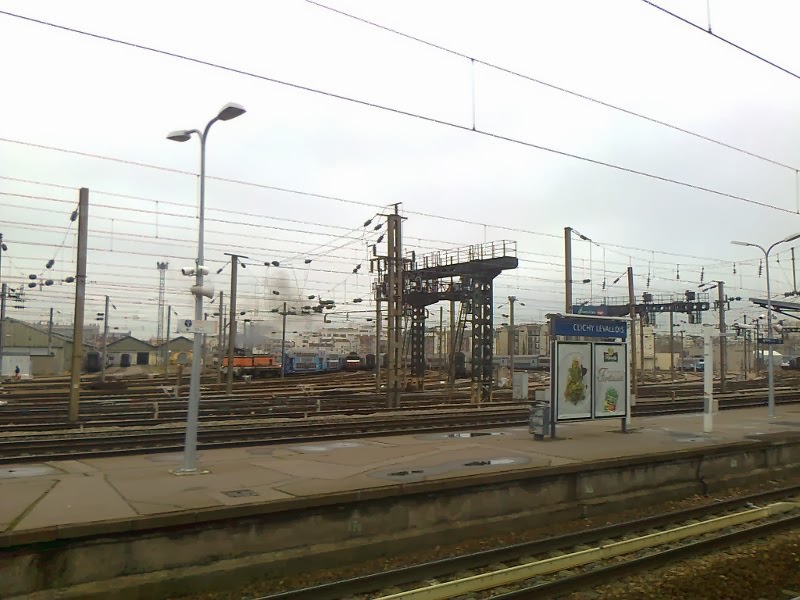
SNCF have a ticket office in this concourse.  There is also an information office on the same floor near the station door and second one on the platform concourse upstairs. You will need to go to this upper level and turn right to get onto the main station concourse area leading to the platforms. There is a regular 10 min train service to the Clichy-Levallois train station. The train service you need is the Nanterre University train, which usually leaves platform 7 or 8. Again you need to check the TV screen for train information, which will give you the departure time and platform the train is leaving from. Clichy-Levallois station is the second stop out from Gare St Lazare. 
The station entrance is under a railway bridge and you will need to turn left, to go out onto road which leads to the Rue Victor Hugo. Follow this road to the Rue Victor Hugo and turn left again. Walk down the street. The shop is located down the street on the right hand side. You can find a detailed map of the area of Paris on Google maps. If you scope down to the Rue Victor Hugo and the station details, print it and take it with you for reference, you can't go wrong. When I arrived on a Tuesday lunchtime, the shop was still closed. I had to wait until 14:00 hrs for the shop to open.

The interesting thing about using the train in Paris is the chance to have a look at all the bikes parked in the bike racks at the stations. I took a few photos of the one outside Gare du Nord on the Rue de Dunkerque.
Quite a few mixte bikes, Motobecane and Peugeot. I also spotted a Roger Riviere bike which I grabbed a photo of. 

What is striking when compared to Ireland is the complete absence of carbon. While cycle shops in Ireland seem to be wedded to selling carbon for every kind of use, the French are much more practical and pragmatic. Steel bikes are much in evidence and in use as a practical means of transport. What else can you expect from a great cycling nation?