Showing posts with label Paris. Show all posts

Saturday, 18 October 2014

1940s Alex Singer - Une Belle Chanteuse


There are some ambitions in life which you may hold in hope, but never reasonably expect to fulfil. I held one in this category for many years, never believing it would ever be fulfilled, but by a unexpected turn of fate over the summer, I was able to realise it. I refer to riding a machine made by the great Parisian constructeur, Alex Singer. I have been fortunate to ride quite a few different hand made British and Irish lightweight steel frames over the years. My curiosity was aroused from childhood, listening to the cycling stories of my parents and the various marques of bicycle ridden by their siblings, friends and clubmates. As my cycling horizon broadened, I became aware of the great tradition of randonneuring in France and the top of the range 'constructeur' built machines. Paris was famous for the 'constructeurs' like Cycles Alex Singer, Cycles René Herse and Cycles Goéland- Louis Moire to name some of the more well known. There was debate amongst owners of Cycles Alex Singer and Cycles René Herse as to who was the better maker, with many favouring René Herse. The closest Britain got to a 'constructeur' was the Taylor brothers from Stockton-on-Tees who had some connection with Goéland-Louis Moire. These beautiful hand crafted French bicycles had mudguards, often had integrated lights, derailleur gears and were fast and light according to what I read. Were they that good I wondered? How did they differ from a British hand made frame? It has taken me decades to find out. I have some experience of riding a 1960 650B Goéland Randonneur built from Reynolds 531, which rides much better than many machines I had ridden up to that point. It was my first real experience of the 650B wheel size on a proper constructeur built randonneuring bicycle and I was very impressed with the integrated bike and it's responsiveness. 


I then unexpectedly had the chance to try a 1940s Alex Singer with 700C wheels. The machine came with some history and was beautifully made, yet understated. The bicycle was originally a full chrome model, but over it's long life, it's original owner, Pierre Berthet, had it enamelled black in the 1970s and fitted with top of the range all French component groupset from the same era. Perhaps some may consider the bike changes to be negative, as the machine was altered from the original constructeur's spec, however, the bike was used and ridden by the original owner and he considered the changes made to have been an upgrade. Many of the components are unique to this machine and were custom made for the owner with a gold anodised finish. 


My first impression was the beauty of the understated paint finish of the frame carried over onto the mudguards, complete with gold lining. The highly polished cranks of the triple chainset gleamed in the sunlight, before lifting the bike equipped with decaleur and sacoche, which was a revelation at how light the machine was. 


After checking the saddle height I got on the bike and from the first input of the pedals it was a joy to ride and just glided along. It looked right and it rode as well, if not better, than it looked. Of all the 27 inch/700c wheel touring/audax bikes I have ever ridden this is without doubt the best to date.


It has the performance and is close to the weight of a top drawer steel competition racing bike but with touring bike frame geometry, and mudguards. Everything just works together so well, no creaks, no movement of the decaleur even on pavé, no chain rub on the front derailleur, the responsiveness of the bike to input and the rock steady handling. The only drawback I found was riding it over pavé. The surface vibration is bearable, however, I found it not as comfortable as the 650B wheel size, transmitting much more of the road vibration. However, my interest has been stirred and I would love to try out a pre 1980 Cycles Alex Singer in 650B wheel size to see how the two machines would compare. I don't wish to denigrate in any way, other artisan frame builders, but can say the Alex Singer is the most joyous 700C wheeled machine I have ridden to date. It is a bit like Edith Piaf singing 'Je ne regrette rien', how do you isolate one element which you can say makes the performance so special? I don't believe you can, it is the sum of the whole. I think the Alex Singer is like that, hard to define one outstanding unique quality, rather it is the sum of the constructuer's skill, attention to detail and experience, all brought to bare in the creation of an individual machine. I always had a smile on my face after riding the Alex Singer.  

Singer in English has a different meaning to French. I think a wordplay on the English meaning, in French, sums up my impression of this 'petite reine' very well - une belle chanteuse.


Saturday, 20 September 2014

Taking your Bicycle by train


How easy is it to take your randonneur or touring bicycle on a train? If the cycling press in Britain is to be believed, not that easy. You need a ticket for a non folding bike and even with that, space is limited and a ticket doesn't guarantee it will travel on the train you believe you are expecting to travel on. Train travel in Britain is awkward and very expensive when compared to other European countries.


France is very different. If you are travelling through Paris, there is no central railway station. You can check via the SNCF website before you go to France to get some idea of which Paris railway station you need to travel from. Train travel is cheap and the electric trains very efficient. Most of the Grand Lignes express style trains I travelled on did not stop for the first hour or so of their journey. The destination board at the platform ends will list the stops, so if the station you intend to travel to is listed, it will stop there. You will require a ticket for your bicycle, whether on the TGV, Grand Lignes or the local trains. There are limited places on the TGV trains, but so far I have not had a problem and that includes travelling on a French public holiday.


The local trains of the Nord-Pas de Calais have bicycle racks in one carriage in the multiple unit, very much like Translink in Northern Ireland. The carriage has a large bicycle icon on the outside, so it is easily seen. You are expected to move quickly onto the train as the trains are very punctual!


The local trains I travelled on in Nord-Pas de Calais were of the double deck carriage type, with the bicycle racks in one corner of the carriage. The bikes are suspended and hang by the front wheel. Again bicycle space is limited, but the service is frequent, so if no room on one train, there should be on the next one.


The TGV service south to Paris Gare du Nord from Valenciennes was the next service that I used. It was an ambition realised to travel by TGV and the fare prices were not much different to the standard Grand Lignes service. Bicycles are carried at one end of the train, within a luggage compartment in one of the driving ends. Each carriage and seat is numbered so your ticket is for a specific seat unlike the Intercity service. The bicycle space is limited in a TGV and your bicycle may be hung on a rack, but the space is also shared with bulky luggage or children's buggies, etc. This will have an effect on how quickly you can disembark from the train, so bear this in mind if you are rushing to catch another service from either the Gare du Nord or any of the other Paris railway stations. The TGV service from Valenciennes runs on local lines to Arras and then runs on the high speed line to near Charles de Gaulle airport where it slows down and uses the existing rail network into the Gare du Nord.


I was catching another train from a different Paris railway station which required a cycle journey from the Rue de Dunkerque outside Paris Gare du Nord to the Gare St Lazaire. There is a cycle route using the bus lanes, but in my opinion requires some knowledge of the street layout between the two destinations. There is some signage but it is not as good as it could be, but again, it is a lot better than nothing. The biggest problem I had on the route was when I got to the Place d'Estienne d'Orves, where it crosses in front of the Eglise de la Trinite. There are a number of tourist buses which stop in front of the church and the road goes round the front of the church and then forks. The map I had was confusing, because it directed an immediate right turn on entry into the Place d'Estienne d'Ovres which is wrong and will take you onto Rue Blanche. You need to go round the front of the church and take the first left up the hill, (there was no street name visible at the end of the road), which is the Rue des Londres. From this junction you need the first road (as opposed to building entrances) to your left which should be the Rue d'Amsterdam which leads onto a tree lined square. There is a taxi rank along the side of the square and the entrance to Paris Gare St Lazaire is under a modern office block on the right hand side of the road. This is the best entrance to use as it is fairly level unlike the main entrance at the front of the station building which will require carrying your bicycle up flights of steps. The entrance from the Rue d'Amsterdam leads straight onto the station platform concourse.


I took the train to Cherbourg to catch the Rosslare Ferry. The first stop on the route was at Caen and we stopped at Carentan. There was a huge Stars and Stripes as well as the French Tricolour flying from the Hotel de Ville in Carentan ahead of the 70th anniversary D-Day commemoration. I will certainly return to explore the Cotentin Peninsular by bicycle at some stage. The railway station at Cherbourg is some distance from the ferry terminals. It is easily cycled but you will have to negotiate all the ferry traffic especially the heavy goods vehicles. If you don't have a ticket, one has to be purchased from the ferry office.


An overnight sailing got to Rosslare at 15.30 in the afternoon. I disembarked with the vehicular traffic and had a friendly greeting from the Gardai before exiting the ferry terminal. The railway station is now located outside the port boundary. There is a limited train service from Rosslare northwards to Dublin and the service is often delayed by the suburban Dublin Dart trains enroute to Dublin Connolly station.

I was able to make the connection with the Dublin-Belfast Enterprise and got the last 20:50 service north. Rail fares like France are very reasonable, E27.30 to Dublin Connolly , and £50.85 first class on the Enterprise Express with a bicycle. The railway staff in Ireland were as friendly and helpful as their French counterparts. An onward ride home from the railway station In Belfast to my overnight accommodation was problem free using the dynamo lighting before travelling home the next day. I will do it again soon.


Thursday, 23 January 2014

Travelling to Cycles Alex Singer


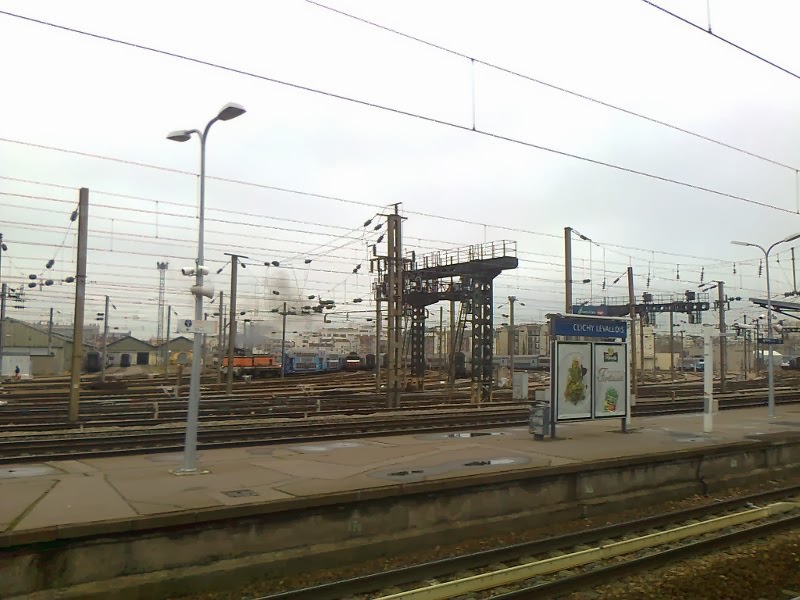
On a recent trip to France, I managed to achieve a long held ambition to visit 53 Rue Victor Hugo, Levallois-Perret, Paris, the shop of constructeur Cycles Alex Singer. The shop is located in the suburbs of Paris beyond the Boulevard Périphérique. As it is not located in the centre of Paris, I was apprehensive about travelling there. In reality it was easy. I checked information on the web before travelling and read all the dire warnings about using the SNCF Transilien suburban service, as being complicated. In actual fact, I didn't find that at all. 

I flew from Dublin to Paris Charles de Gaulle airport. The easiest way to get to Cycles Alex Singer from Charles de Gaulle airport is to take the airport shuttle from Terminal 1 or 3 to the SNCF RER station under Terminal 2 and take the RER route B train to Gare du Nord. The train I took was an express to Gare du Nord, so it couldn't have been simpler. At Gare du Nord, follow the exit (Sortie) signs for the Rue de Dunkerque which is the main entrance to the Gare du Nord. You come up onto to a concourse above the RER platform, with the exit signs directing you to the right up a flight of stairs to the main station concourse and the Rue de Dunkerque. You want to stay on the level you are on (first level) with all the ticket machines, walk straight past all the machines and turn left. You should see signs for the RER route E which is the train service which goes direct to the Gare St Lazare.  (You can try using the Metro if you want a slower, more convoluted and challenging method of travel to the shop!) 

The RER train ticket can be bought from one of the automated ticket machines, which offer English and Spanish language, by touching the appropriate flag on the touch screen. Once you have purchased your ticket, follow the signs to the platforms. The RER station at Gare du Nord is called Magenta. You need to take the train for Haussmann-St Lazare for the Gare St Lazare. The return train to Magenta, is the service to Tournan en Brie. You will need to check the TV information display screens on the platforms. They will tell you the direction of travel, time of trains and most importantly, the platform the train will use. If you are travelling early in the morning, be warned, this service is heavily used by commuters. The fact the carriages are double deck should give you an idea of how much this service is used. Once you arrive at Haussmann-St Lazare, follow the signs from the platform for the Gare St Lazare (trains) which will bring you into a shopping concourse. 

SNCF have a ticket office in this concourse.  There is also an information office on the same floor near the station door and second one on the platform concourse upstairs. You will need to go to this upper level and turn right to get onto the main station concourse area leading to the platforms. There is a regular 10 min train service to the Clichy-Levallois train station. The train service you need is the Nanterre University train, which usually leaves platform 7 or 8. Again you need to check the TV screen for train information, which will give you the departure time and platform the train is leaving from. Clichy-Levallois station is the second stop out from Gare St Lazare. 
The station entrance is under a railway bridge and you will need to turn left, to go out onto road which leads to the Rue Victor Hugo. Follow this road to the Rue Victor Hugo and turn left again. Walk down the street. The shop is located down the street on the right hand side. You can find a detailed map of the area of Paris on Google maps. If you scope down to the Rue Victor Hugo and the station details, print it and take it with you for reference, you can't go wrong. When I arrived on a Tuesday lunchtime, the shop was still closed. I had to wait until 14:00 hrs for the shop to open.

The interesting thing about using the train in Paris is the chance to have a look at all the bikes parked in the bike racks at the stations. I took a few photos of the one outside Gare du Nord on the Rue de Dunkerque.
Quite a few mixte bikes, Motobecane and Peugeot. I also spotted a Roger Riviere bike which I grabbed a photo of. 

What is striking when compared to Ireland is the complete absence of carbon. While cycle shops in Ireland seem to be wedded to selling carbon for every kind of use, the French are much more practical and pragmatic. Steel bikes are much in evidence and in use as a practical means of transport. What else can you expect from a great cycling nation?